
✖

Sep, 01 2026
Dandruff that keeps coming back may not be “just dandruff”
Almost everyone experiences scalp flaking at some point.
A little white flaking on your shoulders is easy to dismiss as ordinary dandruff. You may switch shampoos, wash your hair more frequently or try an anti-dandruff product—and sometimes it improves.
But what if the flakes keep returning?
What if your scalp is also itchy, red, oily, irritated or developing thicker patches?
In that situation, the problem may be more than simple dandruff.
One of the most common conditions behind persistent scalp flaking is seborrheic dermatitis.
Dandruff and seborrheic dermatitis are closely related, and there is considerable overlap between them. But understanding the distinction can help explain why some people improve with occasional anti-dandruff shampoo while others need a more structured treatment plan.
At Skination Clinic, we regularly see patients from Chattarpur and South Delhi as well as Faridabad who have been changing shampoos for months without addressing the reason their scalp keeps flaring.
The first step is not necessarily finding a stronger shampoo.
It is understanding what is happening on your scalp.
What is dandruff?
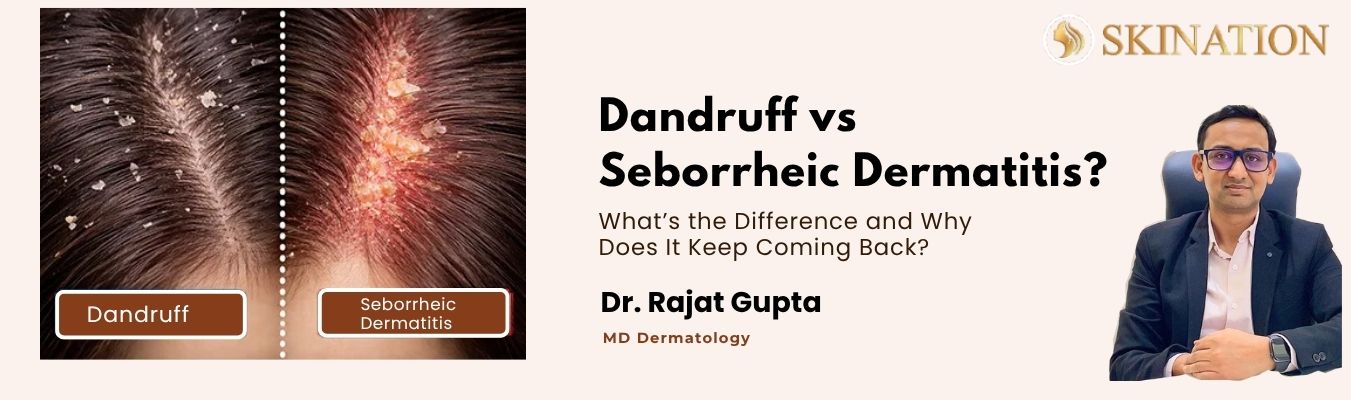
Dandruff is essentially scaling of the scalp without significant inflammation.
The flakes are usually:
* White or greyish
* Fine
* Relatively loose
* More noticeable on dark clothing
* Associated with mild itching in some people
Unlike more inflammatory scalp disorders, uncomplicated dandruff generally does not produce marked redness, swelling or thick crusting.
Dandruff is often considered the mildest end of the same spectrum of conditions that includes seborrheic dermatitis.
That is why the two can sometimes be difficult to separate.
What is seborrheic dermatitis?
Seborrheic dermatitis is a chronic inflammatory skin condition that commonly affects areas rich in sebaceous glands.
These include:
* Scalp
* Hairline
* Eyebrows
* Sides of the nose
* Behind the ears
* Beard area
* Upper chest
On the scalp, seborrheic dermatitis may cause:
* Flaking
* Redness
* Itching
* Greasy or yellowish scales
* Irritation
* More extensive patches of inflammation
It can range from mild to quite pronounced.
Importantly, seborrheic dermatitis is not caused by poor hygiene.
A person can wash their hair regularly and still develop it.
The condition is thought to involve an interaction between skin oil, the yeast Malassezia, individual susceptibility and the inflammatory response of the skin. (aad.org)
Dandruff vs seborrheic dermatitis: what is the difference?
The easiest way to think about it is:
Dandruff = mainly scaling
Seborrheic dermatitis = scaling + inflammation
But there is overlap, and the distinction is not always absolute.
Feature Dandruff Seborrheic Dermatitis
Flaking Common Common
Scalp redness Usually minimal Common
Itching Mild or variable Often more noticeable
Greasy/yellowish scales Less typical More common
Thick inflamed patches Unusual Can occur
Eyebrow/nose/ear involvement Uncommon Common
Chronic recurrence Common Common
Requires medical treatment Sometimes More often
The severity and pattern matter more than the label alone.
Why does dandruff keep coming back?
This is one of the most common questions patients ask.
The answer is that dandruff and seborrheic dermatitis are often recurrent conditions rather than one-time infections.
Even when the scalp becomes completely clear, the tendency can return.
Several factors may contribute.
1. Malassezia yeast
Malassezia is a normal organism found on human skin.
It is not something you “catch” from another person.
In susceptible individuals, the interaction between Malassezia, scalp oils and the immune response can contribute to inflammation and scaling. (dermnetnz.org)
This is one reason anti-fungal shampoos can be useful in managing dandruff and seborrheic dermatitis.
2. Oily scalp
Seborrheic dermatitis tends to affect areas where sebaceous glands are active.
If your scalp becomes oily quickly, you may notice that flakes become more obvious or the condition becomes more difficult to control.
However, oily skin is not the same as poor hygiene.
3. Weather changes
Many people notice seasonal fluctuations.
Cold, dry weather can worsen scalp dryness and flaking, while changes in humidity, heat and sweating may also influence symptoms.
The exact pattern differs from person to person.
4. Stress
Stress can contribute to flares of several inflammatory skin conditions, including seborrheic dermatitis.
Patients often notice that their scalp becomes more symptomatic during periods of:
* Work pressure
* Poor sleep
* Emotional stress
* Illness
Stress may not be the original cause, but it can be an important trigger for recurrence.
5. Incorrect shampoo use
Sometimes the problem isn’t that the anti-dandruff shampoo doesn’t work.
It is that it is being used incorrectly.
Many medicated shampoos need to remain on the scalp for a few minutes before being rinsed.
Using a small amount, applying it only to the hair rather than the scalp, or rinsing immediately may reduce its effectiveness.
The exact instructions depend on the active ingredient and formulation.
Is dandruff caused by poor hygiene?
No.
This is an important misconception.
Dandruff and seborrheic dermatitis can affect people who wash their hair frequently and people who wash less frequently.
Poor hygiene is not considered the underlying cause.
However, regular scalp cleansing can help remove excess oil, scale and product build-up and can be an important part of management.
The goal is appropriate scalp care—not excessive washing or aggressive scrubbing.
Can dandruff cause hair fall?
This is another common concern.
Dandruff itself does not usually cause permanent hair loss.
However, significant scalp inflammation and repeated scratching can contribute to temporary increased shedding or hair breakage.
If your scalp is very itchy, repeatedly scratching it can cause:
* Mechanical damage to hairs
* Skin irritation
* Small abrasions
* Increased inflammation
There is also an important distinction between scalp flaking and genuine hair loss.
If you are noticing:
* Widening of the hair part
* Receding hairline
* Reduced hair density
* Increased shedding for several months
* Patchy areas of hair loss
then dandruff may not be the main explanation.
A separate hair-loss condition should be assessed.
Can dandruff cause permanent baldness?
Ordinary dandruff does not usually cause permanent baldness.
However, severe or untreated inflammatory scalp disorders can sometimes cause substantial irritation and scratching.
If there is:
* Pain
* Pus
* Crusting
* Bleeding
* Thick plaques
* Patchy hair loss
* Scarring
* Significant tenderness
you should not assume it is ordinary dandruff.
Conditions such as scalp psoriasis, fungal infection, folliculitis and other inflammatory scalp disorders can sometimes resemble severe dandruff but require different treatment.
What conditions can be mistaken for dandruff?
This is where self-treatment can become frustrating.
Not every flaky scalp has dandruff.
Scalp psoriasis
Psoriasis can produce well-defined, thicker plaques with prominent scaling. It may extend beyond the hairline.
Atopic or contact dermatitis
A scalp reaction to a hair dye, fragrance, cosmetic ingredient or other product can produce itching, redness and scaling.
Tinea capitis
A fungal infection of the scalp can cause scaling and may be associated with broken hairs or patches of hair loss. It requires appropriate medical treatment.
Folliculitis
Inflammation around hair follicles can produce bumps, pustules or tenderness rather than simple flaking.
Product build-up
Dry shampoo, styling products and other hair products can accumulate on the scalp and produce visible flakes or irritation.
Psoriasis - seborrheic dermatitis overlap
Some people have features of both conditions, sometimes referred to clinically as sebopsoriasis.
This is one reason a scalp that does not respond to conventional dandruff treatment deserves assessment rather than simply adding another shampoo.
How is dandruff treated?
Treatment depends on the severity and the underlying diagnosis.
For mild dandruff, medicated shampoos can often be sufficient.
Common active ingredients include:
* Ketoconazole
* Zinc pyrithione
* Selenium sulfide
* Salicylic acid
* Coal tar
Different ingredients work in different ways, and not every product suits every scalp.
Some reduce fungal activity, some help loosen scale and others reduce inflammation or excess scaling.
The choice should depend on the patient’s scalp, severity and tolerance.
How is seborrheic dermatitis treated?
Treatment is generally aimed at controlling both the yeast component and inflammation.
Depending on the severity, a dermatologist may recommend:
Anti-fungal treatment
Anti-fungal shampoos or topical treatments can reduce Malassezia-associated inflammation.
Anti-inflammatory treatment
Short courses of appropriately selected topical anti-inflammatory medication may be prescribed during flares.
These should not be used indiscriminately or indefinitely without medical supervision.
Scale control
When scales are thick, treatments that help loosen and remove them may be incorporated.
Maintenance treatment
This is particularly important.
Once the scalp becomes clear, many patients stop treatment completely.
If the condition is recurrent, however, a dermatologist may recommend a maintenance schedule to reduce the frequency of future flares.
This is one reason seborrheic dermatitis can feel like a condition that “never goes away.”
The goal is often long-term control rather than a one-time cure.
Why does my dandruff improve with shampoo and then return?
This is completely possible.
Medicated shampoo can suppress the scaling and inflammation, but it may not permanently remove the underlying tendency to develop seborrheic dermatitis.
So you may experience:
Flare → treatment → improvement → stopping treatment → recurrence
That doesn’t necessarily mean that the treatment “failed.”
It may simply mean that your scalp requires an appropriate maintenance strategy.
Your dermatologist can tell you how often treatment should be continued based on your symptoms and the active ingredient being used.
Should you wash your hair every day if you have dandruff?
There is no single rule for everyone.
Some people with oily scalps may benefit from frequent cleansing, while others may find that excessive washing or harsh shampoos cause irritation.
What matters is:
* Your scalp type
* Oil production
* Severity of scaling
* Shampoo formulation
* Hair texture
* Presence of inflammation
A medicated shampoo should be used according to its instructions rather than simply increasing the frequency because the flakes are bothersome.
Can oiling the scalp cure dandruff?
This is a common practice in India, but oil is not a treatment for the underlying cause of seborrheic dermatitis.
Heavy oiling can sometimes make the scalp feel temporarily more comfortable if it is dry, but in a person with an oily, inflamed scalp it may not be helpful and can make the scalp feel heavier or greasier.
If you enjoy oiling your hair, discuss how it fits into your scalp-care routine with your dermatologist rather than assuming that more oil will treat dandruff.
Can dandruff be cured permanently?
For many people, dandruff or seborrheic dermatitis can be very effectively controlled.
But recurrent seborrheic dermatitis is generally considered a chronic condition with periods of improvement and flare.
So instead of thinking:
“I need a shampoo that will cure my dandruff forever.”
it is more realistic to think:
“I need a treatment and maintenance routine that keeps my scalp under control.”
This change in expectation can make management much easier.
When should you see a dermatologist for dandruff?
You should consider a dermatology consultation if:
* Dandruff persists despite appropriate anti-dandruff shampoo.
* Your scalp is significantly red.
* Itching is severe.
* You have thick scales or plaques.
* There is bleeding or crusting.
* You have pus-filled bumps.
* Your scalp is painful or tender.
* You notice patchy hair loss.
* Scaling extends to your eyebrows, ears or sides of the nose.
* The condition repeatedly returns despite treatment.
* You are unsure whether it is dandruff, psoriasis, fungal infection or another scalp condition.
A persistent flaky scalp is often treatable—but the treatment needs to match the diagnosis.
What I look for as a dermatologist
When someone comes to me saying, “I have severe dandruff,” I don’t immediately assume that dandruff is the diagnosis.
I look at:
* The type of scale
* Whether the scalp is red
* Whether the scale is greasy or dry
* The distribution
* Whether the hairline is involved
* Whether the eyebrows or ears are affected
* Whether there is hair loss
* Whether there are pustules or crusting
* The patient’s previous treatment history
Sometimes it is straightforward seborrheic dermatitis.
Sometimes it is scalp psoriasis.
Sometimes it is contact dermatitis.
Sometimes it is a fungal infection.
And sometimes a patient has more than one condition at the same time.
That distinction determines the treatment.
Dandruff vs seborrheic dermatitis: the bottom line
Dandruff and seborrheic dermatitis exist on a closely related spectrum, but persistent flaking accompanied by redness, inflammation, greasy scales or involvement of the eyebrows, nose or ears is more suggestive of seborrheic dermatitis.
The condition is not caused by poor hygiene, and it does not usually cause permanent baldness.
It can, however, be recurrent.
That means the most effective approach is often not to keep switching shampoos every few weeks, but to establish:
the correct diagnosis → appropriate treatment → maintenance plan.
At Skination Clinic, patients with persistent dandruff, scalp itching and recurrent flaking can be evaluated by a dermatologist to determine whether the problem is simple dandruff, seborrheic dermatitis, psoriasis, folliculitis, fungal infection or another scalp condition.
Patients from Chattarpur and South Delhi can visit our Chattarpur clinic, while patients from Faridabad and surrounding areas can consult at our Faridabad clinic.
If your dandruff keeps coming back, the answer may not be a stronger shampoo. It may be a better diagnosis.
Frequently Asked Questions
1. What is the difference between dandruff and seborrheic dermatitis?
Dandruff mainly causes scalp flaking without significant inflammation. Seborrheic dermatitis is an inflammatory condition that can cause flaking along with redness, itching and greasy or yellowish scales. The two conditions overlap considerably.
2. Why does my dandruff keep coming back?
Dandruff and seborrheic dermatitis are often recurrent conditions. Factors such as scalp oil, Malassezia yeast, weather changes, stress and individual susceptibility can contribute to repeated flares. (aad.org)
3. Is dandruff caused by poor hygiene?
No. Dandruff is not simply a result of poor hygiene. It can affect people who wash their hair regularly. Appropriate scalp cleansing can help control symptoms, but excessive washing or scrubbing is not the solution.
4. Can dandruff cause hair loss?
Ordinary dandruff does not usually cause permanent hair loss. Severe itching and repeated scratching can contribute to temporary shedding or hair breakage. Persistent or patchy hair loss should be evaluated separately.
5. Can seborrheic dermatitis cause baldness?
Seborrheic dermatitis does not usually cause permanent baldness. However, significant inflammation and scratching can damage the scalp temporarily. If there are patches of hair loss or scarring, another scalp condition should be considered.
6. Can I use anti-dandruff shampoo every day?
It depends on the product, active ingredient and condition of your scalp. Some medicated shampoos are used several times a week during treatment and less frequently for maintenance. Follow the product instructions or your dermatologist’s advice.
7. Does oiling the scalp cure dandruff?
No. Oiling does not treat the underlying mechanisms of seborrheic dermatitis. In some people with an oily scalp, heavy oiling may make the scalp feel greasier or more uncomfortable.
8. Can dandruff be permanently cured?
Mild dandruff can often be controlled very well. Recurrent seborrheic dermatitis is usually managed as a chronic condition, meaning that appropriate treatment and maintenance can keep it under control even if occasional flares occur.
9. How do I know if my dandruff is actually scalp psoriasis?
Scalp psoriasis often produces thicker, more sharply defined plaques and may extend beyond the hairline. It can look similar to severe dandruff, so persistent or treatment-resistant scaling should be assessed by a dermatologist.
10. When should I see a dermatologist for dandruff?
See a dermatologist if your dandruff doesn’t improve with appropriate treatment, is associated with significant redness or itching, produces thick plaques or crusting, causes pain or bleeding, involves other facial areas, or is accompanied by patchy hair loss.
11. Can stress make dandruff worse?
Stress can contribute to flares of seborrheic dermatitis in susceptible individuals. Managing stress and maintaining a consistent treatment routine may therefore help reduce recurrence.
12. Is seborrheic dermatitis contagious?
No. Seborrheic dermatitis is not considered a contagious condition. Malassezia yeast is normally present on human skin; the problem relates to how the skin responds to it rather than catching an infection from another person. (dermnetnz.org)
About the Author
Dr. Rajat Gupta is a dermatologist at Skination Clinic, with a focus on evidence-based diagnosis and personalised treatment of skin and hair disorders.
At Skination, treatment is based on the patient’s diagnosis, scalp condition, medical history and individual needs rather than a one-treatment-fits-all approach.
Skination Clinic:
Chattarpur, South Delhi | Faridabad