

✖

Jun, 06 2026
Hair loss treatment has evolved significantly over the last few years. Earlier, patients were mostly limited to medications, supplements, and hair transplant procedures. Today, regenerative dermatology has opened newer possibilities for improving scalp health, strengthening weakened follicles, and supporting hair regrowth without surgery.
Among the most discussed modern hair treatments are:
* PRP (Platelet-Rich Plasma)
* GFC (Growth Factor Concentrate)
* Exosome therapy
At our clinics in Faridabad and Chhatarpur, patients frequently ask:
“Which treatment is best for hair loss — PRP, GFC, or exosomes?”
The answer is not always straightforward because each treatment works differently, has different biological mechanisms, and may be suitable for different stages and patterns of hair loss.
As a dermatologist managing hair loss regularly, I believe it is important to understand that no single treatment is universally superior for every patient. The best outcomes usually come from proper diagnosis, individualized treatment planning, and combining regenerative therapies appropriately when needed.
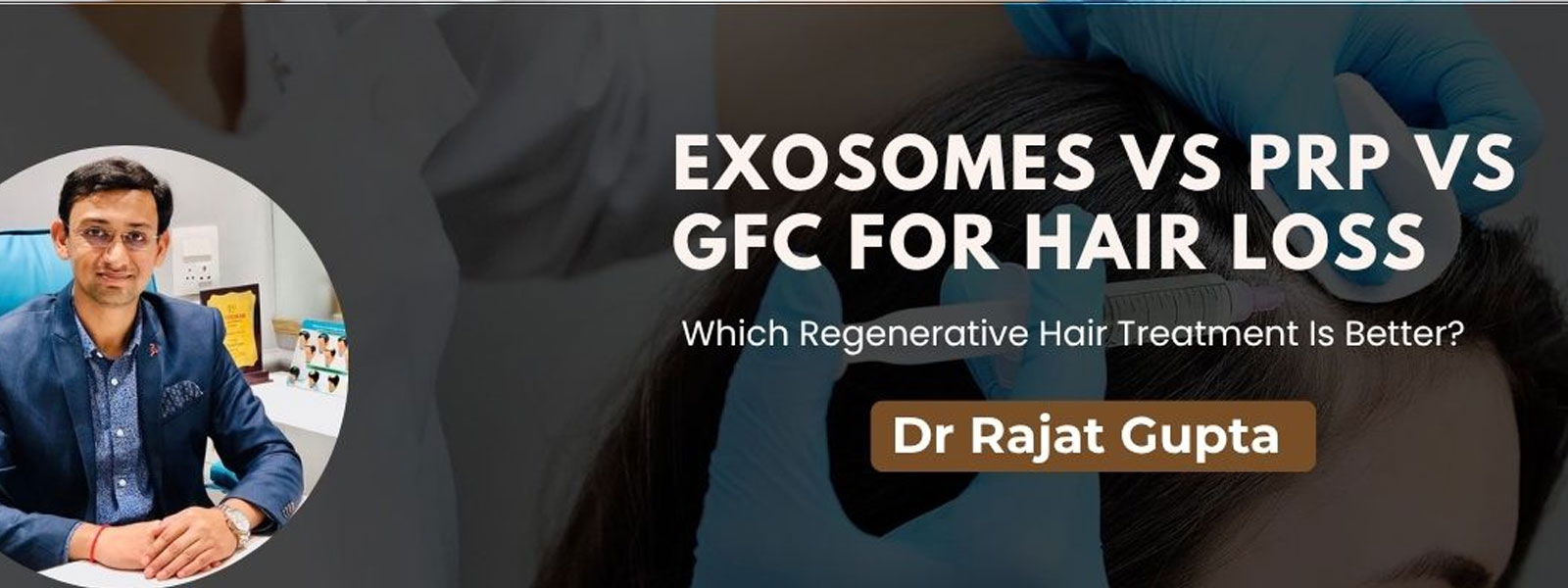
This article explains the scientific difference between PRP, GFC, and exosome therapy for hair loss — including how they work, who may benefit from them, and how modern regenerative hair treatments are changing dermatology practice.
Understanding Hair Loss – Why Early Treatment Matters
Hair loss is often progressive.
Many patients ignore early signs such as:
* Increased hair shedding
* Widening partition
* Reduced density
* Visible scalp
* Thinning near the temples
* Receding hairline
By the time significant thinning becomes visible, hair follicles may already be weakened.
Hair loss can occur due to:
* Genetic predisposition
* Hormonal changes
* Stress
* Nutritional deficiencies
* Thyroid imbalance
* PCOS
* Post-illness shedding
* Aging
* Scalp inflammation
Modern regenerative treatments aim to improve the scalp environment and stimulate weakened follicles before permanent miniaturization occurs.
This is why early intervention often produces better outcomes.
What Is PRP for Hair Loss?
PRP stands for Platelet-Rich Plasma therapy.
It is one of the most widely performed regenerative hair procedures globally.
In PRP treatment:
1. A small amount of the patient’s blood is collected
2. It is processed in a centrifuge system
3. Platelet-rich plasma containing concentrated growth factors is isolated
4. The plasma is injected into areas of scalp thinning
Platelets contain biologically active growth factors that may help:
* Stimulate dormant follicles
* Improve blood supply
* Reduce hair shedding
* Strengthen weak follicles
* Improve scalp healing
PRP is commonly used for:
* Male pattern hair loss
* Female pattern thinning
* Stress-related hair fall
* Post-COVID hair shedding
* Early-stage androgenetic alopecia
Because PRP uses the patient’s own blood, it is generally considered safe when performed under proper medical supervision.
What Is GFC Hair Treatment?
GFC stands for Growth Factor Concentrate.
It is considered an advanced evolution of traditional PRP-based therapy.
In GFC treatment, blood is processed differently to isolate highly concentrated growth factors from platelets in a more targeted manner.
The idea behind GFC is to deliver:
* More purified growth factors
* Better concentration consistency
* Reduced inflammatory components
* Enhanced regenerative signaling
Compared to traditional PRP, GFC protocols are often marketed as more standardized and concentrated.
Growth factors commonly involved include:
* PDGF
* VEGF
* EGF
* TGF-beta
These signaling molecules may help support follicular activity and scalp regeneration.
GFC is commonly considered in:
* Early to moderate hair thinning
* Patients looking for regenerative hair therapy
* Patients seeking advanced non-surgical treatment options
What Are Exosomes?
Exosome therapy is one of the newest and most advanced developments in regenerative medicine.
Exosomes are microscopic extracellular vesicles released by cells that carry:
* Growth factors
* Cytokines
* Proteins
* Signaling molecules
* Regenerative messengers
They help cells communicate with each other and influence tissue repair processes.
In regenerative dermatology, exosomes are being explored for:
* Hair restoration
* Skin rejuvenation
* Wound healing
* Collagen stimulation
Unlike PRP and GFC, exosomes are not derived directly from the patient’s own blood during the procedure.
They are laboratory-prepared regenerative signaling particles designed to support cellular repair and regenerative pathways.
How Do Exosomes Potentially Help Hair Loss?
Exosome-based therapies are believed to help by:
* Supporting follicular signaling
* Reducing inflammation
* Improving scalp microenvironment
* Stimulating regenerative pathways
* Enhancing follicular activity
Exosomes are currently gaining attention because they may influence multiple biological pathways involved in hair growth.
However, it is important to understand that exosome therapy in hair restoration is still an evolving field.
While early studies and clinical experiences are promising, ongoing scientific evaluation is still continuing globally.
Patients should always seek proper medical guidance rather than relying purely on marketing claims surrounding regenerative treatments.
PRP vs GFC vs Exosomes – What Is the Main Difference?
The simplest way to understand these treatments is:
PRP uses platelet-rich plasma from your own blood
GFC isolates concentrated purified growth factors
Exosomes deliver advanced regenerative signaling molecules
All three aim to improve follicular health, but they differ in:
* Biological mechanism
* Preparation process
* Regenerative signaling intensity
* Standardization
* Clinical evidence levels
Which Treatment Is Better for Hair Loss?
There is no universal answer because results depend on:
* Type of hair loss
* Stage of thinning
* Age
* Follicular activity
* Scalp condition
* Nutritional status
* Hormonal factors
* Treatment consistency
For many patients with early hair thinning, PRP itself may provide significant improvement.
Some patients may benefit from more advanced regenerative protocols involving GFC or exosome-based approaches depending on scalp assessment and clinical goals.
However, no regenerative treatment can completely reverse advanced follicular destruction in long-standing baldness.
This is why realistic expectations are extremely important.
Is Exosome Therapy Better Than PRP?
This is currently one of the most searched questions online.
Exosomes are newer and scientifically exciting because they involve advanced cellular signaling pathways. However, “newer” does not automatically mean universally superior.
PRP remains:
* Widely studied
* Clinically established
* Commonly performed
* Supported by substantial dermatology experience
Exosome therapy is promising but still evolving in terms of long-term evidence and standardization across protocols.
A scientifically honest approach is important when discussing regenerative medicine with patients.
Can These Treatments Be Combined?
Yes.
In modern hair restoration practice, combination approaches are increasingly being explored.
Depending on the patient’s condition, regenerative therapies may sometimes be combined with:
* Medical hair treatment
* Nutritional correction
* Microneedling
* Low-level laser therapy
* Scalp treatments
* Hair transplant support protocols
Hair restoration works best when multiple contributing factors are addressed together.
Who Is the Ideal Candidate for Regenerative Hair Treatments?
Patients who generally respond best include:
* Early-stage hair thinning
* Active but weakened follicles
* Diffuse hair loss
* Stress-related shedding
* Genetic hair loss in earlier stages
* Patients seeking non-surgical options
Patients with completely inactive follicles or advanced baldness may have limited response.
This is why proper scalp evaluation by a dermatologist is essential before choosing treatment.
Why Proper Diagnosis Matters More Than Trend-Based Treatment
One of the biggest mistakes in hair treatment today is blindly following social media trends without proper diagnosis.
Hair fall may be linked to:
* Iron deficiency
* Vitamin deficiencies
* Hormonal imbalance
* Thyroid disorders
* PCOS
* Chronic stress
* Inflammatory scalp disease
If these underlying causes are ignored, even advanced regenerative procedures may deliver suboptimal results.
At our clinics, treatment planning focuses on identifying the cause of hair loss rather than simply recommending trending procedures.
The Shift Toward Regenerative Dermatology
Hair restoration is increasingly moving toward regenerative and biologically driven therapies.
Patients today are looking for:
* Non-surgical solutions
* Minimal downtime
* Natural improvement
* Follicular preservation
* Early intervention approaches
This is why treatments such as:
* PRP
* GFC
* Exosomes
* Growth factor therapies
* Regenerative scalp procedures
Are becoming increasingly popular in dermatology practice.
However, medical expertise and patient selection remain the most important factors for achieving meaningful results.
Final Thoughts from Dr. Rajat Gupta
PRP, GFC, and exosome therapy are all part of the evolving field of regenerative hair restoration.
Rather than asking which treatment is universally “best,” the more important question is:
Which treatment is most appropriate for a particular patient’s scalp condition and stage of hair loss?
Scientific evaluation, individualized planning, realistic expectations, and consistency are essential for successful hair restoration outcomes.
Early treatment almost always offers better chances of preserving hair density and slowing progressive thinning.
Frequently Asked Questions (FAQs)
Is PRP better than GFC?
Both are regenerative treatments, but GFC aims to provide more concentrated and purified growth factors compared to traditional PRP.
Are exosomes FDA-approved for hair loss?
Regulatory status varies across regions, and ongoing research is still evaluating exosome therapy in regenerative medicine.
Which treatment is less painful?
Comfort levels are generally similar, although techniques and protocols may differ.
How many sessions are required?
The number of sessions depends on the severity and type of hair loss, along with the treatment protocol chosen.
Can women undergo PRP, GFC, or exosome treatment?
Yes. These regenerative treatments may be performed in both men and women depending on clinical evaluation.