

✖

Aug, 24 2026
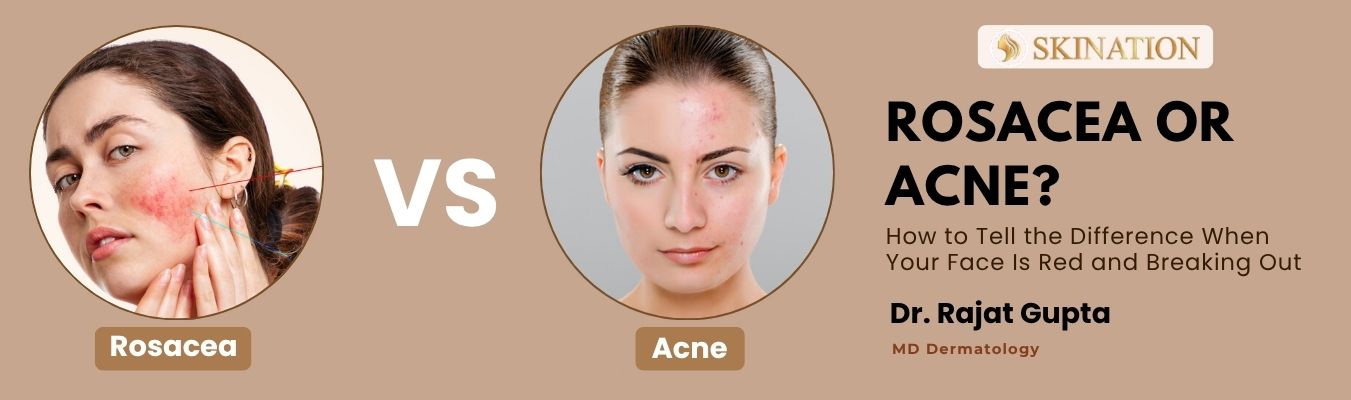
Rosacea or acne? Why the distinction matters
Redness, pimples and bumps on the face are very commonly labelled as acne.
But not every facial breakout is acne.
Rosacea can also cause red, acne-like bumps and pustules, particularly around the cheeks and nose. The two conditions can therefore look surprisingly similar, especially when you are looking at your skin yourself.
The difference matters because acne and rosacea are different skin conditions and may require very different treatment approaches.
A useful starting point is this:
Blackheads and whiteheads strongly suggest acne, while persistent facial redness, frequent flushing, burning or stinging and acne-like bumps may point towards rosacea.
However, it is not always that straightforward. Some people can have both acne and rosacea, while other conditions such as perioral dermatitis or folliculitis can also resemble acne.
At Skination Clinic, we often see patients from Chattarpur and across South Delhi as well as Faridabad who have spent months changing acne products without realising that their underlying problem may be something else.
So how can you tell the difference?
What is acne?
Acne vulgaris is an inflammatory condition involving the hair follicles and sebaceous glands.
It can produce several types of lesions:
* Blackheads or open comedones
* Whiteheads or closed comedones
* Red pimples
* Pus-filled pimples
* Nodules
* Cysts
Acne can affect the forehead, cheeks, chin, jawline, chest, shoulders and back.
Hormonal changes, increased sebum production, follicular blockage, inflammation and other biological factors can contribute to acne.
Adult acne is also common, particularly in women, and may have hormonal associations.
One of the most useful clinical clues is the presence of comedones.
Blackheads and whiteheads are typical of acne
If your skin has a significant number of blackheads and whiteheads, acne is much more likely.
Rosacea generally does not produce comedones.
That distinction can be very useful—but it should not be used as a self-diagnosis because different skin conditions can coexist.
What is rosacea?
Rosacea is a chronic inflammatory skin condition that most commonly affects the central face.
It can cause:
* Facial flushing
* Persistent facial redness or colour change
* Red or pink bumps
* Pustules
* Burning or stinging
* Increased skin sensitivity
* Visible small blood vessels
* Dry or irritated skin
* Eye symptoms in some patients
Rosacea often affects the cheeks and nose, although other areas can also be involved.
Importantly, rosacea does not necessarily appear as bright red skin in every person.
In Indian and darker skin tones, the colour changes can be subtler and may appear pink, brownish, violet or simply darker than the surrounding skin. Symptoms such as warmth, burning and stinging may therefore be particularly useful clues.
A dermatologist diagnoses rosacea primarily by examining the skin and eyes and understanding the patient’s history and pattern of symptoms. (AAD)
Rosacea vs acne: 8 clues that can help
1. Do you have blackheads and whiteheads?
This is one of the most useful differences.
More suggestive of acne:
* Blackheads
* Whiteheads
* Blocked pores
* Comedones
More suggestive of rosacea:
* Red bumps
* Pustules
* Background facial redness
* Flushing
* Burning or stinging
Comedones are not a typical feature of rosacea. (AAD)
If you have both comedones and persistent facial redness, it is possible that you have acne with a rosacea component, rather than one condition alone.
2. Does your face flush suddenly?
Think about what happens to your face after:
* Sun exposure
* Exercise
* Heat
* Hot beverages
* Spicy food
* Emotional stress
* Certain skincare products
Does your face suddenly become warm or visibly red?
Frequent flushing is a classic clue towards rosacea.
Over time, some people may find that the redness no longer completely disappears between episodes.
This pattern is very different from ordinary acne, where redness is generally associated with individual inflammatory lesions rather than repeated episodes of whole-face flushing.
3. Does your skin burn or sting?
This is a clue patients often overlook.
Someone with rosacea may say:
“My face burns when I apply skincare.”
Or:
“Even products that used to suit me suddenly sting.”
Rosacea-prone skin can be highly sensitive.
Acne-prone skin can also become irritated, particularly after overusing exfoliating acids, retinoids or other active ingredients. But persistent burning or stinging combined with facial redness should make you reconsider whether the problem is simply acne.
4. Where are the bumps located?
Acne can occur almost anywhere there are hair follicles and sebaceous glands.
Common areas include:
* Forehead
* Cheeks
* Chin
* Jawline
* Chest
* Back
Rosacea has a stronger tendency to involve the central face, particularly the cheeks and nose.
A pattern of:
cheek/nose redness + flushing + acne-like bumps
should raise the possibility of rosacea.
5. Can you see tiny blood vessels?
Small visible blood vessels, especially over the cheeks and nose, can occur with rosacea.
They are not a typical feature of acne.
However, their absence does not rule out rosacea.
This is particularly relevant in Indian skin, where vascular changes may be less visually obvious than in lighter skin.
6. Does your skin feel unusually sensitive?
If your skincare routine has suddenly become difficult to tolerate, think beyond acne.
Symptoms such as:
* Burning
* Stinging
* Tightness
* Heat
* Redness after products
* Sensitivity to sun or heat
can occur with rosacea.
The answer isn’t necessarily to remove every active ingredient forever. The more important question is why your skin is reacting in the first place.
7. Are your eyes also irritated?
Rosacea can involve the eyes.
Some patients experience:
* Dryness
* Burning
* Grittiness
* Watery eyes
* Red eyes
* Irritated eyelids
If recurrent facial redness and acne-like bumps occur together with unexplained eye symptoms, mention this during your dermatology consultation.
Eye involvement can be clinically important and should not simply be dismissed as “sensitive eyes.” (AAD)
8. Have acne treatments actually made things worse?
This is one of the most important practical clues.
If you’ve repeatedly used acne products but:
* Your face is becoming increasingly red
* Your skin burns or stings
* Breakouts keep returning
* Your cheeks and nose remain red
* You flush easily
* Your skin has become unusually sensitive
then it is worth reconsidering the diagnosis.
The question may no longer be:
“Which acne product should I try next?”
It may be:
“Is this actually acne?”
Can acne and rosacea occur together?
Yes.
This is an important point.
Having rosacea does not protect you from developing acne, and having acne does not rule out rosacea.
A patient may have:
* Blackheads and whiteheads
* Hormonal acne around the jawline
* Persistent cheek redness
* Flushing
* Sensitive skin
all at the same time.
This is why dermatologists don’t diagnose solely by counting pimples.
We look at the pattern of the entire skin.
That includes:
* Type of lesions
* Distribution
* Presence or absence of comedones
* Background redness
* Flushing
* Sensitivity
* Triggers
* Previous treatment response
* Associated eye symptoms
What else can look like acne?
Rosacea is only one possible acne mimic.
Other conditions can produce acne-like bumps, including:
Perioral dermatitis
Often presents with small bumps around the mouth, nose or eyes and may be associated with burning or irritation.
Folliculitis
Inflammation or infection of hair follicles can create acne-like bumps and may sometimes be itchy.
Steroid-related facial eruptions
Topical corticosteroid use on the face can sometimes lead to acne-like or rosacea-like eruptions.
Irritant or allergic reactions
A new skincare product can cause redness and bumps that may be mistaken for acne.
Malassezia folliculitis
This can produce small, relatively uniform, often itchy follicular bumps and is managed differently from conventional acne.
So if your “acne” doesn’t behave like typical acne, don’t simply keep adding more products.
Why treating rosacea like acne can backfire
Many acne routines are built around active ingredients designed to unclog pores and reduce inflammation.
These can be extremely useful when appropriately prescribed.
But rosacea-prone skin may be more sensitive.
Repeated exfoliation, aggressive scrubbing, excessive active ingredients or unsuitable skincare can aggravate irritation.
That doesn’t mean people with rosacea can never use acne-related ingredients.
It means the diagnosis and the skin’s tolerance need to guide treatment.
The aim should not be:
“How can I dry these pimples out?”
The aim should be:
“What is causing these lesions, and what treatment will control the condition without unnecessarily irritating the skin?”
How is rosacea diagnosed?
There is no single blood test that confirms ordinary rosacea.
A dermatologist generally makes the diagnosis by assessing:
* Facial appearance
* Pattern of redness
* Flushing history
* Type of lesions
* Skin sensitivity
* Triggers
* Eye symptoms
* Previous treatments
Sometimes additional evaluation may be required to rule out other conditions that can produce persistent facial colour changes or similar symptoms. (AAD)
This is particularly important if the presentation is unusual or treatment has repeatedly failed.
How is rosacea treated?
Treatment depends on the patient’s specific presentation.
There isn’t one universal “rosacea cream.”
1. Gentle skincare
A simple, non-irritating routine is often an important foundation.
This generally includes:
* Gentle cleansing
* Appropriate moisturisation
* Daily broad-spectrum sunscreen
* Avoidance of unnecessary irritation
Sun protection is particularly important because UV exposure can worsen rosacea in many patients. (AAD)
2. Identifying triggers
Different people have different triggers.
Commonly reported triggers include:
* Heat
* Sun exposure
* Spicy foods
* Alcohol
* Emotional stress
* Hot drinks
Not every trigger applies to every patient, so maintaining a personal pattern can be more useful than following a long list of restrictions. (AAD)
3. Prescription treatment
Depending on the clinical type of rosacea, dermatologists may prescribe topical or oral medication.
Options can include medicines directed at inflammatory acne-like lesions or persistent redness.
Treatment should be selected according to the individual’s presentation rather than copied from someone else’s prescription. (AAD)
4. Laser or light-based treatment
For selected patients with persistent redness or visible blood vessels, laser or light-based treatments may be useful.
The choice of technology and settings matters, particularly in Indian skin.
This is one reason vascular treatments should be performed following an appropriate dermatological assessment rather than treating “facial redness” as a generic cosmetic concern.
When should you see a dermatologist?
Consider getting a professional assessment if:
* Your acne treatment isn’t working.
* Your face stays red between breakouts.
* You flush frequently.
* Your skin burns or stings.
* Your cheeks and nose are persistently red.
* You have visible tiny blood vessels.
* You develop unexplained eye irritation.
* Your skin has become unusually sensitive.
* Your breakouts are leaving scars.
* You keep changing skincare products without improvement.
If you’re repeatedly treating the wrong condition, more treatment isn’t necessarily the answer. Better diagnosis is.
Rosacea or acne? Treat the diagnosis, not just the pimple
Acne and rosacea can look similar, but they are not the same condition.
Blackheads and whiteheads suggest acne.
Flushing, persistent central facial redness, burning, stinging and acne-like bumps suggest that rosacea should be considered.
And sometimes, both conditions can coexist.
The right treatment therefore begins with understanding the skin rather than immediately reaching for another active ingredient.
At Skination Clinic, our approach is diagnosis-first. The aim is to understand whether a patient’s facial redness and breakouts represent acne, rosacea, a combination of conditions or another acne mimic before recommending treatment.
Patients can consult at our Skination Clinic in Chattarpur, South Delhi, or our Faridabad clinic, depending on their location.
If you’ve been treating “acne” for months but your face remains persistently red, sensitive or prone to flushing, it may be time to ask a more important question:
Is it really acne?
Frequently Asked Questions
1. How can I tell if I have rosacea or acne?
Blackheads and whiteheads strongly favour acne. Persistent facial redness, flushing, burning, stinging and acne-like bumps—especially around the cheeks and nose—can suggest rosacea. A dermatologist can distinguish between the two by assessing the overall pattern.
2. Can rosacea look like acne?
Yes. Rosacea can cause red bumps and pustules that resemble acne. This is one of the main reasons the two conditions are commonly confused. (AAD)
3. Does rosacea cause blackheads?
Blackheads and whiteheads are not typical features of rosacea. If comedones are prominent, acne is more likely. However, acne and rosacea can occur together.
4. Can I have acne and rosacea at the same time?
Yes. A person can have conventional acne as well as rosacea. This is why the presence of one condition does not automatically exclude the other.
5. Why does my face burn when I apply skincare?
Burning or stinging can occur when the skin barrier is irritated, but persistent burning associated with facial redness can also be a clue to rosacea. A dermatologist can determine whether rosacea, irritation, contact dermatitis or another condition is responsible.
6. What triggers rosacea?
Common triggers include heat, sunlight, spicy food, hot drinks, alcohol and emotional stress, although triggers vary from person to person. (AAD)
7. Can rosacea be permanently cured?
Rosacea is generally considered a chronic condition. It can often be controlled very effectively with appropriate treatment and trigger management, but patients may experience periods of flare and remission.
8. Is rosacea common in Indian skin?
Rosacea can occur in Indian and darker skin tones, although redness may be less visually obvious. Brownish, violet or subtle colour changes and symptoms such as burning and warmth can therefore be important clues.
9. Can laser treatment help rosacea?
Selected laser and light-based treatments can improve persistent redness and visible blood vessels in appropriate patients. The choice of treatment depends on the clinical presentation and skin type, so assessment by an experienced dermatologist is important. (AAD)
10. When should I see a dermatologist for facial redness and pimples?
If redness persists between breakouts, your face flushes frequently, skincare burns or stings, conventional acne treatment isn’t helping, or you have eye symptoms, a dermatology consultation is worthwhile.
About the Author
Dr. Rajat Gupta is a dermatologist at Skination Clinic, with a focus on evidence-based diagnosis and personalised dermatological treatment.
At Skination, treatment recommendations are based on the patient’s diagnosis, skin type, severity, medical history and individual goals rather than a one-treatment-fits-all approach.
Consult Skination Clinic:
Chattarpur, South Delhi | Faridabad