


✖

Aug, 26 2026
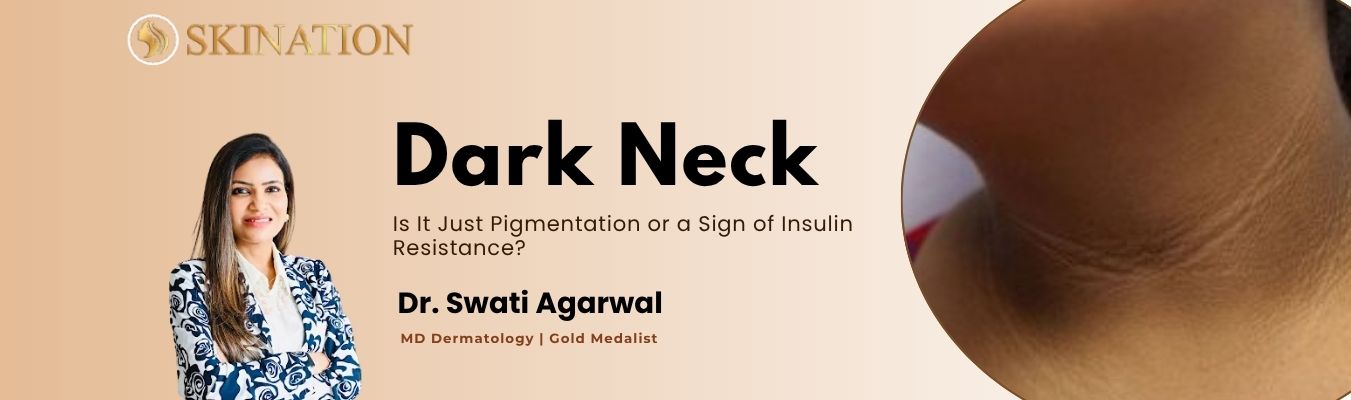
Dark neck: pigmentation or something more?
A darker neck is often treated as a purely cosmetic problem.
Many people try scrubs, bleaching creams, exfoliating acids or home remedies hoping to “remove” the darkness.
But sometimes, darkening of the neck is not simply pigmentation.
A common cause is a condition called acanthosis nigricans, in which the skin becomes darker, thicker and often velvety. It commonly affects the back or sides of the neck and can also appear in the armpits, groin and other skin folds. Importantly, acanthosis nigricans can be associated with insulin resistance, prediabetes, diabetes, obesity and conditions such as PCOS.
This does not mean that everyone with a dark neck has diabetes.
There are several possible causes of neck pigmentation, and the appearance of the skin matters.
That is why the first question should not be:
“Which cream will make my neck lighter?”
It should be:
“Why has my neck become darker?”
What does acanthosis nigricans look like?
Acanthosis nigricans typically produces skin that is:
* Darker than the surrounding skin
* Slightly thickened
* Velvety or soft to touch
* More prominent in the folds or creases
* Sometimes associated with skin tags
The back of the neck is one of the most common locations.
The colour can range from brown to dark brown or almost black, depending on the individual’s natural skin tone.
In Indian skin, the contrast can sometimes be subtle initially, and patients may simply notice that the neck looks “dirty” or darker than the face.
However, scrubbing does not remove acanthosis nigricans because the change is occurring within the skin itself rather than being surface dirt. (AAD)
Why does insulin resistance cause a dark neck?
This is where the skin can sometimes provide an important clue about what is happening inside the body.
Insulin resistance means that the body’s tissues do not respond normally to insulin.
To compensate, the body may produce more insulin.
Persistently elevated insulin levels can influence growth pathways in skin cells, contributing to the thickening and darkening characteristic of acanthosis nigricans. (DermNet®)
So a dark, thickened, velvety neck can sometimes be a visible dermatological clue to insulin resistance.
It does not mean that a person necessarily has diabetes.
In fact, acanthosis nigricans can appear before diabetes develops, which is one reason dermatologists may recommend appropriate medical evaluation when the clinical appearance suggests it. The American Academy of Dermatology notes that acanthosis nigricans can sometimes be a warning sign of prediabetes or diabetes. (AAD)
Does having a dark neck mean you have diabetes?
No.
This is an important distinction.
Acanthosis nigricans can be associated with:
* Insulin resistance
* Prediabetes
* Type 2 diabetes
* Obesity
* Metabolic syndrome
* PCOS
* Certain hormonal disorders
* Certain medications
* Familial forms of acanthosis nigricans
And some people develop acanthosis nigricans without an identifiable underlying medical condition. (DermNet®)
Therefore, seeing a dark neck does not mean you should assume that you have diabetes.
Instead, the skin finding should be interpreted in the context of your age, weight, family history, menstrual and hormonal history, medications and other clinical features.
Can PCOS cause a dark neck?
Yes, indirectly.
Polycystic ovary syndrome (PCOS) is commonly associated with insulin resistance, although not every person with PCOS has insulin resistance.
When insulin resistance is present, acanthosis nigricans may develop.
A woman with:
* Irregular periods
* Acne
* Increased facial or body hair
* Weight gain
* Difficulty losing weight
* Darkening of the neck or armpits
may benefit from a medical evaluation rather than treating the pigmentation alone.
The skin may be giving you a clue that deserves a broader assessment.
What if my blood sugar is normal?
This is another common question.
A person can have normal blood glucose while still having insulin resistance, particularly in earlier stages, because the body may compensate by producing more insulin and maintaining glucose levels within the normal range.
Therefore, a normal glucose reading does not automatically explain away a clinically typical case of acanthosis nigricans.
At the same time, a dermatologist should not diagnose insulin resistance purely from the appearance of the neck.
The skin needs to be examined first, and any appropriate metabolic evaluation should be decided based on the individual’s overall clinical picture.
Not every dark neck is acanthosis nigricans
This is extremely important.
There are several other reasons why the neck can look darker.
1. Friction and irritation
Repeated rubbing from:
* Tight collars
* Jewellery
* Clothing
* Frequent shaving
* Scrubbing
can contribute to irritation and post-inflammatory pigmentation.
2. Sun exposure
The neck is often overlooked when applying sunscreen.
Repeated UV exposure can contribute to uneven pigmentation and tanning.
3. Post-inflammatory pigmentation
Eczema, dermatitis, itching or irritation can leave behind darker pigmentation after the inflammation settles.
4. Fungal or superficial infections
Certain superficial fungal conditions can produce patches of altered colour on the neck and may be mistaken for simple pigmentation.
5. Other pigmentary conditions
Some patients have conditions that primarily affect pigmentation without the thickened, velvety texture typical of acanthosis nigricans.
6. Medication-related changes
Certain medicines can be associated with acanthosis nigricans or other pigmentation changes. The medication history is therefore relevant when assessing unexplained darkening.
This is why looking at the texture as well as the colour is important.
How can you tell whether it is acanthosis nigricans?
There is no reliable home test.
A dermatologist usually looks at:
* Colour
* Texture
* Thickness
* Distribution
* Symmetry
* Other affected body areas
* Presence of skin tags
* Duration
* Associated symptoms
* Medical history
* Medication history
The diagnosis is usually clinical.
If the appearance is uncertain, additional evaluation may occasionally be required. (DermNet®)
Should you get your blood sugar checked if you have a dark neck?
If a dermatologist suspects acanthosis nigricans, it can be reasonable to discuss evaluation for an underlying metabolic or hormonal condition with your doctor.
Depending on the individual situation, the doctor may consider tests related to glucose metabolism and other relevant risk factors.
This is particularly worth discussing if you also have:
* Overweight or obesity
* A strong family history of diabetes
* PCOS
* Irregular periods
* Multiple skin tags
* High blood pressure
* Abnormal cholesterol or triglycerides
* Previous abnormal glucose readings
The exact tests should be individualised rather than automatically ordering every possible blood test.
Can scrubbing remove a dark neck?
No—if the underlying problem is acanthosis nigricans.
This is one of the most common mistakes.
People often scrub the neck aggressively with:
* Loofahs
* Body scrubs
* Lemon
* Baking soda
* Exfoliating acids
* Rough towels
But if the darkening is due to acanthosis nigricans, scrubbing does not address the underlying mechanism.
Worse, repeated irritation can cause inflammation and potentially make pigmentation more noticeable.
The American Academy of Dermatology specifically advises against aggressively trying to scrub away acanthosis nigricans. (AAD)
Will treating insulin resistance make the dark neck disappear?
Sometimes it improves significantly.
When acanthosis nigricans is related to an underlying condition such as prediabetes, diabetes or insulin resistance, addressing that underlying problem can help the skin gradually improve. (AAD)
However, improvement is not necessarily immediate.
And treating the underlying condition does not guarantee complete clearance in every patient.
This is where dermatological treatment can sometimes be considered in addition to managing the underlying medical cause.
How is dark neck pigmentation treated?
Treatment depends entirely on the diagnosis.
There is no single best cream for every dark neck.
If it is acanthosis nigricans
The first priority is identifying and addressing any underlying condition.
Depending on the cause, this may involve:
* Lifestyle modification
* Weight management where appropriate
* Management of prediabetes or diabetes
* Evaluation and treatment of PCOS or other hormonal disorders
* Reviewing potentially contributing medications
As the underlying condition improves, the skin may gradually become lighter and smoother.
Dermatological treatment
Once the underlying cause has been addressed or appropriately investigated, dermatologists may consider topical treatments to improve the texture and pigmentation.
Depending on the individual case, treatment may include prescription retinoids or keratolytic agents.
Procedural treatments may occasionally be considered for selected patients, but these need to be approached cautiously—particularly in Indian skin, where unnecessary inflammation can itself lead to post-inflammatory pigmentation.
The objective should be controlled improvement, not aggressive skin lightening.
Why “fairness” treatments can make the problem worse
A dark neck can be emotionally frustrating, particularly when the face and neck have noticeably different colours.
But repeatedly applying strong bleaching products without knowing the diagnosis is not a good strategy.
I often see patients who have tried multiple combinations of:
* Strong exfoliating acids
* Steroid-containing creams
* Unregulated fairness products
* Home remedies
* Frequent scrubbing
This can create another layer of irritation and pigmentation on top of the original problem.
The skin needs to be diagnosed before it is treated.
When should you see a dermatologist for a dark neck?
A dermatology consultation is particularly worthwhile if:
* The neck has become progressively darker.
* The skin feels thicker or velvety.
* The pigmentation is also present in the armpits or groin.
* You have multiple new skin tags.
* You have PCOS or irregular periods.
* You have unexplained weight gain.
* You have a family history of diabetes.
* The pigmentation appeared without an obvious reason.
* Home remedies and pigmentation creams have not helped.
* The darkening appeared suddenly or progressed rapidly.
A sudden appearance of widespread, velvety darkening, particularly without the usual risk factors, deserves prompt medical assessment because rare forms of acanthosis nigricans can be associated with underlying disease. (AAD)
This does not mean that sudden darkening automatically indicates cancer; it means that unusual presentations should not simply be treated as cosmetic pigmentation.
Dark neck in children and teenagers
Parents sometimes notice a darker, thicker neck in children or teenagers and assume it is dirt.
It may actually be acanthosis nigricans.
Because acanthosis nigricans can be associated with insulin resistance and metabolic risk, a child with a typical appearance should be assessed by a qualified healthcare professional rather than repeatedly scrubbed at home. (AAD)
Early recognition can be useful because metabolic risk factors may be addressed before they progress.
What I look for as a dermatologist
When a patient comes to me with a dark neck, I don’t start by asking:
“Which pigmentation cream have you tried?”
I first want to know:
* When did the pigmentation start?
* Is the skin becoming thicker?
* Is it velvety?
* Is the same change present in the armpits?
* Are there skin tags?
* Has there been recent weight change?
* Are periods regular?
* Is there a history of PCOS?
* Is there a family history of diabetes?
* Which medications are being used?
* Has the patient been aggressively exfoliating the area?
These questions can change the entire treatment plan.
Because sometimes the right treatment for a dark neck isn’t another pigmentation cream.
Sometimes the skin is telling us to look deeper.
Dark neck: don’t just treat the colour
A darker neck can be caused by ordinary tanning or pigmentation—but when the skin is thicker, velvety and darker, acanthosis nigricans should be considered.
And because acanthosis nigricans can be associated with insulin resistance, prediabetes, diabetes and hormonal conditions such as PCOS, it is worth understanding the cause before trying to lighten it.
The good news is that many causes are manageable.
The key is diagnosis first, treatment second.
At Skination Clinic, patients with unexplained neck pigmentation can be evaluated from both a dermatological and clinical perspective, with treatment tailored to the underlying cause rather than simply attempting to lighten the skin.
Patients can consult at our Skination Clinic in Chattarpur, South Delhi, or at our Faridabad clinic, depending on their location.
If your neck has gradually become darker and especially if the skin feels thicker or velvety, don’t assume that it is simply dirt or stubborn pigmentation.
It may be worth getting your skin—and your underlying health—checked.
Frequently Asked Questions
1. Is a dark neck always caused by insulin resistance?
No. Dark neck pigmentation has several possible causes, including tanning, friction, irritation, post-inflammatory pigmentation and other skin conditions. A thick, velvety darkening of the neck can be characteristic of acanthosis nigricans, which is often associated with insulin resistance.
2. Does a dark neck mean I have diabetes?
Not necessarily. Acanthosis nigricans can occur in people without diabetes, but it can sometimes be a sign of prediabetes, diabetes or another metabolic condition. Appropriate testing should be decided based on the person’s overall clinical picture. (AAD)
3. What does acanthosis nigricans look like?
It typically appears as darker, thicker and velvety skin, often on the back or sides of the neck. It may also occur in the armpits, groin and other folds. (AAD)
4. Can PCOS cause a dark neck?
PCOS can be associated with insulin resistance, and insulin resistance can contribute to acanthosis nigricans. However, not every person with PCOS develops acanthosis nigricans.
5. Can a dark neck be caused by weight gain?
It can. Obesity is a common association with acanthosis nigricans, although a dark neck can occur for many other reasons as well. (AAD)
6. Can I scrub away a dark neck?
If the darkening is due to acanthosis nigricans, scrubbing will not remove it. Aggressive scrubbing can irritate the skin and potentially worsen pigmentation.
7. Will acanthosis nigricans go away if I lose weight?
In people whose acanthosis nigricans is related to excess weight and metabolic factors, significant weight loss can lead to substantial improvement and sometimes clearing of the skin. However, the response varies from person to person.
8. What blood tests are needed for a dark neck?
There is no single test required for everyone. If the appearance suggests acanthosis nigricans, your doctor may recommend evaluation of glucose metabolism and other relevant metabolic or hormonal factors based on your age, symptoms and risk profile.
9. Can pigmentation creams treat acanthosis nigricans?
Topical dermatological treatments may improve the appearance in selected patients, but they should not replace evaluation and management of an underlying medical cause. Treating the underlying problem is an important part of management.
10. When should I see a dermatologist for a dark neck?
See a dermatologist if the pigmentation is persistent, progressively increasing, thick or velvety, associated with skin tags or similar pigmentation elsewhere, or if you have risk factors such as PCOS, obesity or a family history of diabetes.
11. Can children get a dark neck from acanthosis nigricans?
Yes. Acanthosis nigricans can occur in children and teenagers and may be associated with metabolic risk factors. A persistent thick, velvety dark neck in a child should be assessed rather than repeatedly scrubbed.
12. Can a dermatologist tell whether my dark neck is pigmentation or acanthosis nigricans?
In many cases, yes. A dermatologist can usually recognise the characteristic clinical appearance and decide whether additional medical evaluation is appropriate.
About the Author
Dr. Swati Agarwal is a dermatologist and senior consultant with a focus on evidence-based dermatology, pigmentation disorders, acne, hair disorders and aesthetic dermatology.
At Skination Clinic, treatment plans are based on the patient’s diagnosis, skin type, medical history and individual goals rather than a one-treatment-fits-all approach.
Skination Clinic:
Chattarpur, South Delhi | Faridabad