✖

Sep, 28 2026
Stretch marks are one of those skin concerns where expectations and reality can be very different.
A patient may come into the clinic and say:
“Doctor, I just want these marks completely gone.”
Another may ask:
“I have been applying creams for six months. Why aren’t they disappearing?”
And someone else may say:
“My stretch marks are old and white. Is there anything I can still do?”
These are all reasonable questions.
But before discussing treatment, there is something important to understand:
Stretch marks are a type of scar-like change in the skin.
They develop when the skin undergoes changes faster than its supporting structure can adapt.
They can occur during:
* Pregnancy
* Puberty
* Rapid weight gain
* Rapid weight loss
* Muscle growth
* Certain hormonal conditions
* Prolonged use of corticosteroids in some circumstances
They are extremely common.
And while they can often be significantly improved, no responsible dermatologist should promise that every stretch mark can be erased completely.
What exactly is a stretch mark?
The medical term is striae.
A stretch mark develops when the skin undergoes structural changes involving the dermis.
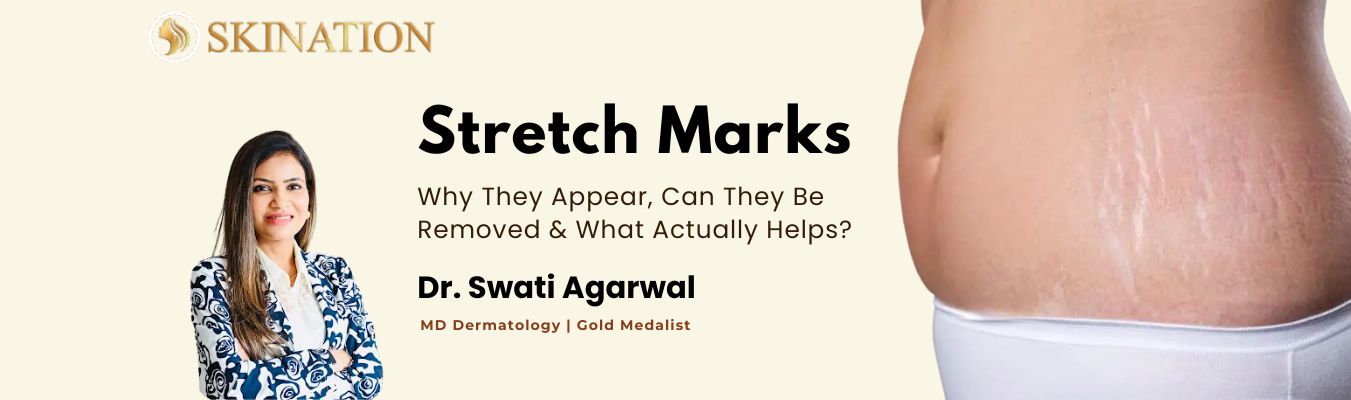
Initially, some stretch marks appear:
pink, red, purple or reddish-brown.
These are often called striae rubrae.
Over time, many become:
pale, white or silvery.
These are referred to as striae alba.
This distinction matters because newer stretch marks and older stretch marks don’t behave in exactly the same way.
Why do stretch marks happen?
The name “stretch mark” makes it sound as though stretching alone causes them.
It isn’t quite that simple.
Mechanical stretching can contribute, but biological factors—including changes in the dermal connective tissue—also play a role.
That is why two people can undergo a similar amount of weight gain and have completely different outcomes.
One develops extensive striae.
The other develops almost none.
Genetics matters.
Hormonal influences matter.
The rate and degree of tissue change matter.
And individual skin biology matters.
Where do stretch marks usually appear?
They can occur almost anywhere where the skin undergoes significant change.
Common locations include:
* Abdomen
* Hips
* Thighs
* Buttocks
* Breasts
* Upper arms
* Lower back
In people who develop them during puberty or rapid muscle growth, they may also appear around the shoulders, back or arms.
Why do some stretch marks become red?
Newer stretch marks often have more colour because of changes in the underlying skin and blood vessels.
They may look:
* Pink
* Red
* Purple
* Reddish-brown
At this stage, they may also feel slightly raised or different from the surrounding skin.
Over time, the colour often fades.
The marks then become lighter and more atrophic.
This is why the timing of treatment matters.
Newer marks may offer a different treatment opportunity compared with longstanding white striae.
Why do old stretch marks become white?
With time, the inflammatory and vascular component of a stretch mark tends to diminish.
The mark becomes paler and its texture may become more noticeable.
These older marks are generally more challenging to improve.
This doesn’t mean treatment is useless.
It means the realistic goal changes from:
“make it disappear”
to:
“make it less visible and improve the texture and colour difference.”
Can creams completely remove stretch marks?
Usually, no.
This is one of the most important things to know before spending money on stretch-mark products.
Moisturisers can help keep the skin comfortable and hydrated.
Some topical ingredients have been studied for improving early striae.
But there is no ordinary cream that reliably erases established stretch marks.
If someone promises:
“100% stretch mark removal with this cream”
be cautious.
The skin has undergone a structural change.
A moisturiser can improve how the skin feels.
It cannot simply recreate the original dermal architecture.
What about cocoa butter and oils?
Cocoa butter, almond oil, coconut oil and other moisturising products are often recommended for prevention or treatment.
They can certainly moisturise the skin.
But moisturisation should not be confused with proven elimination of stretch marks.
Many people apply oils during pregnancy because they make the skin feel softer and more comfortable.
That’s reasonable.
But no oil can guarantee that pregnancy stretch marks will not occur.
Genetic and biological factors play a major role.
Can stretch marks be prevented?
There is no guaranteed prevention method.
Maintaining healthy skin hydration is reasonable, but it cannot completely override genetic susceptibility or hormonal and mechanical factors.
During pregnancy, for example, stretch marks may develop despite excellent skincare.
So if you develop them:
It is not because you “didn’t moisturise enough.”
This is important because patients often blame themselves unnecessarily.
Do stretch marks disappear after pregnancy?
They often become less noticeable with time.
The colour may fade substantially.
However, established stretch marks may remain visible.
The amount of spontaneous improvement varies between individuals.
This is why it is useful to distinguish:
natural fading
from
actual treatment-induced improvement.
Can weight loss remove stretch marks?
Weight loss may change the overall appearance of the body, but it does not necessarily eliminate existing stretch marks.
In fact, after substantial weight change, some marks may become more noticeable because of changes in the surrounding skin.
Stretch marks are structural changes within the skin.
Losing the weight that contributed to their development doesn’t automatically restore the affected dermis to its previous state.
What treatments can improve stretch marks?
There is no single procedure that works equally well for every type.
Treatment may include:
* Fractional lasers
* Radiofrequency-based treatments
* Microneedling
* RF microneedling
* Selected topical treatments
* Combination approaches
The choice depends on:
* Age of the stretch marks
* Colour
* Texture
* Location
* Skin type
* Degree of contrast with surrounding skin
* Patient expectations
What about microneedling?
Microneedling creates controlled microscopic injuries in the skin.
This stimulates a wound-healing response and can encourage dermal remodelling.
For some patients with stretch marks, this may improve:
* Texture
* Surface irregularity
* Overall visibility
It is not a magic eraser.
Multiple sessions may be required, and results vary.
What is RF microneedling?
RF microneedling combines two technologies:
microneedling + radiofrequency energy.
The needles allow controlled delivery into the skin, while radiofrequency adds thermal energy at selected depths depending on the device.
This can be useful for certain textural concerns.
But again:
The technology should be selected after looking at the stretch marks—not simply because RF microneedling is popular.
Can lasers treat stretch marks?
Yes, selected lasers may improve certain types of stretch marks.
The appropriate laser depends on whether the marks are:
* Red
* Purple
* White
* Texturally depressed
Different wavelengths and technologies target different components.
This is particularly important in Indian skin because the risk of post-inflammatory pigmentation needs to be considered when selecting and adjusting laser treatments.
More aggressive does not automatically mean better.
The treatment needs to be appropriate for the patient’s skin type.
Which is better: laser or microneedling?
There is no universal winner.
For some patients, laser-based treatment may be more appropriate.
For others, microneedling or RF microneedling may be preferable.
The answer depends on:
the type of stretch mark + skin type + colour + texture + treatment goal.
Sometimes combination treatment provides a better strategy than relying on one modality.
Can white stretch marks be treated?
Yes.
But expectations need to be realistic.
White stretch marks are older and often more established.
They may respond to treatments that stimulate dermal remodelling, but complete removal is unlikely.
The aim is usually to make them:
* Less obvious
* More even in texture
* Closer in appearance to surrounding skin
A meaningful improvement can still make a cosmetic difference.
Can red stretch marks be treated?
They may respond differently from older white striae.
When redness is prominent, vascular-targeting approaches may sometimes be considered, depending on the appearance and the patient’s skin.
Early treatment can be useful in selected patients, although not every new stretch mark requires a procedure.
A dermatologist can assess whether treatment is worthwhile.
Does early treatment matter?
Potentially, yes.
Newer stretch marks are biologically different from mature white striae.
If someone notices rapidly developing red or purple marks, it’s reasonable to have them assessed rather than waiting several years and then expecting an older mark to behave like a new one.
However:
Early treatment doesn’t guarantee complete prevention of progression.
Are stretch marks permanent?
They are best thought of as long-lasting structural changes.
They often fade significantly.
But complete spontaneous disappearance is uncommon.
This is why dermatological treatment focuses on improving their appearance rather than promising eradication.
Can exercise remove stretch marks?
Exercise is excellent for overall health and can improve muscle tone and body composition.
But exercise doesn’t directly remove established striae.
Strength training may change the underlying body contour, but the stretch mark itself remains a change within the skin.
Are stretch marks caused by poor skin care?
No.
This is an important misconception.
Stretch marks are not evidence that someone neglected their skin.
They can occur in people who moisturise every day and follow an excellent skincare routine.
Genetic susceptibility and hormonal and mechanical factors are much more important.
Can teenagers get stretch marks?
Yes.
Puberty is a common time for stretch marks to develop because the body can change rapidly in a relatively short period.
They may appear on the:
* Back
* Thighs
* Hips
* Breasts
* Buttocks
* Shoulders
They can occur in both girls and boys.
Can men get stretch marks?
Absolutely.
Men may develop striae during:
* Puberty
* Rapid weight gain
* Muscle growth
* Bodybuilding
* Significant changes in body composition
They are not a condition exclusive to women or pregnancy.
Are sudden widespread stretch marks ever a medical warning sign?
Most stretch marks are harmless.
However, unusually extensive or rapidly appearing striae—particularly if they are wide, dark or associated with other symptoms—may occasionally warrant medical evaluation.
Certain hormonal disorders and prolonged corticosteroid exposure can be associated with prominent striae.
So if stretch marks appear suddenly without an obvious explanation, especially when accompanied by other physical changes, speak with a doctor.
What should you realistically expect from treatment?
This is perhaps the most important part of the consultation.
If you have old white stretch marks, I would not promise:
“They will disappear.”
I would instead explain:
“We can work on making them less noticeable.”
Treatment may improve:
* Texture
* Colour contrast
* Surface depression
* Overall visibility
But the response varies considerably between patients.
The goal is improvement—not perfection.
How many sessions will I need?
There is no universal number.
Treatment depends on:
* Procedure selected
* Extent of stretch marks
* Age of the marks
* Skin type
* Treatment intensity
* Individual healing response
A dermatologist may recommend a series of sessions followed by reassessment.
Importantly, more sessions are not automatically better.
The skin needs time to respond between treatments.
Can stretch marks come back after treatment?
The treated marks may remain improved, but new stretch marks can develop if the skin undergoes another period of significant stretching or hormonal change.
For example:
* Another pregnancy
* Significant weight change
* Rapid muscle gain
can produce new striae.
Treatment of existing marks does not prevent the body from developing new ones in the future.
The biggest mistake people make
They wait until the stretch marks are several years old and then expect a single procedure to erase them.
The second mistake is jumping from one miracle cream to another.
The better approach is:
Identify the type → assess the skin → set realistic expectations → choose the appropriate treatment.
That is how we approach stretch marks at Skin Nation.
Frequently Asked Questions
1. What causes stretch marks?
Stretch marks develop when changes in the skin and underlying tissue are associated with structural changes in the dermis. Pregnancy, puberty, rapid weight changes, muscle growth, hormonal factors and genetic susceptibility can contribute.
2. Can stretch marks be completely removed?
Usually not. Dermatological treatments can make many stretch marks less noticeable and improve their texture or colour, but complete removal cannot be guaranteed.
3. Can stretch-mark creams remove old white marks?
Established white stretch marks generally cannot be erased with ordinary moisturisers. Some topical treatments may have a role in selected early striae, but mature marks often require procedural approaches if significant improvement is desired.
4. Are red stretch marks easier to treat than white stretch marks?
Newer red or purple marks are biologically different from mature white striae and may respond differently to treatment. A dermatologist can determine which approach is appropriate.
5. Can laser treatment improve stretch marks?
Selected laser technologies can improve the colour and/or texture of certain stretch marks. The choice of laser depends on the type of striae and the patient’s skin type.
6. Is microneedling effective for stretch marks?
Microneedling may improve the texture and visibility of some stretch marks by stimulating dermal remodelling. Multiple sessions may be needed.
7. Is RF microneedling good for stretch marks?
RF microneedling may be considered for selected textural stretch marks. Whether it is appropriate depends on the patient’s skin, type of striae and treatment goals.
8. Can pregnancy stretch marks be prevented?
There is no guaranteed method of prevention. Regular moisturisation can support skin comfort, but it cannot eliminate the biological and genetic factors involved in stretch-mark formation.
9. Do stretch marks disappear after pregnancy?
They often fade and become less prominent over time, but established stretch marks may remain visible.
10. Can weight loss remove stretch marks?
Weight loss does not directly remove established stretch marks because they represent structural changes within the skin.
11. Can men get stretch marks?
Yes. Men can develop stretch marks during puberty, rapid weight gain, muscle growth and other periods of significant body change.
12. Can teenagers develop stretch marks?
Yes. Rapid growth during puberty is a common setting for stretch marks.
13. Why are my stretch marks suddenly appearing?
Rapid body changes, hormonal influences and genetic susceptibility can contribute. If extensive marks appear unexpectedly without an obvious cause, medical evaluation may be appropriate.
14. How many treatments are needed for stretch marks?
There is no standard number. The required treatment course depends on the age, colour, texture and extent of the stretch marks and the procedure being used.
15. When should I see a dermatologist for stretch marks?
A consultation is useful if the marks are extensive, rapidly appearing, cosmetically bothersome, associated with other symptoms or if you want to understand which treatment is actually appropriate for your type of stretch marks.
Final Takeaway
Stretch marks are extremely common, but they aren’t simply a cosmetic problem caused by “not moisturising enough.”
They reflect changes within the structure of the skin.
That is why:
creams may help moisturise → procedures may improve texture → lasers may address selected components → but complete erasure cannot be promised.
If you’re considering treatment, the first step should be identifying whether your stretch marks are new or old, red or white, mainly colour-related or mainly textural.
At Skination Clinic, we assess the individual pattern before recommending a treatment approach.
Consultations are available at:
Chattarpur, South Delhi | Faridabad
The goal isn’t to promise that your stretch marks never existed.
The goal is to make them much less noticeable.
About the Author
Dr. Swati Agarwal is a dermatologist and senior consultant at Skination Clinic, with an evidence-based approach to medical and aesthetic dermatology.
Her approach is diagnosis first, treatment second, with treatment selected according to the patient’s skin type, concern, medical history and realistic expectations.
Skination Clinic
Chattarpur, South Delhi | Faridabad