
✖

Oct, 19 2026
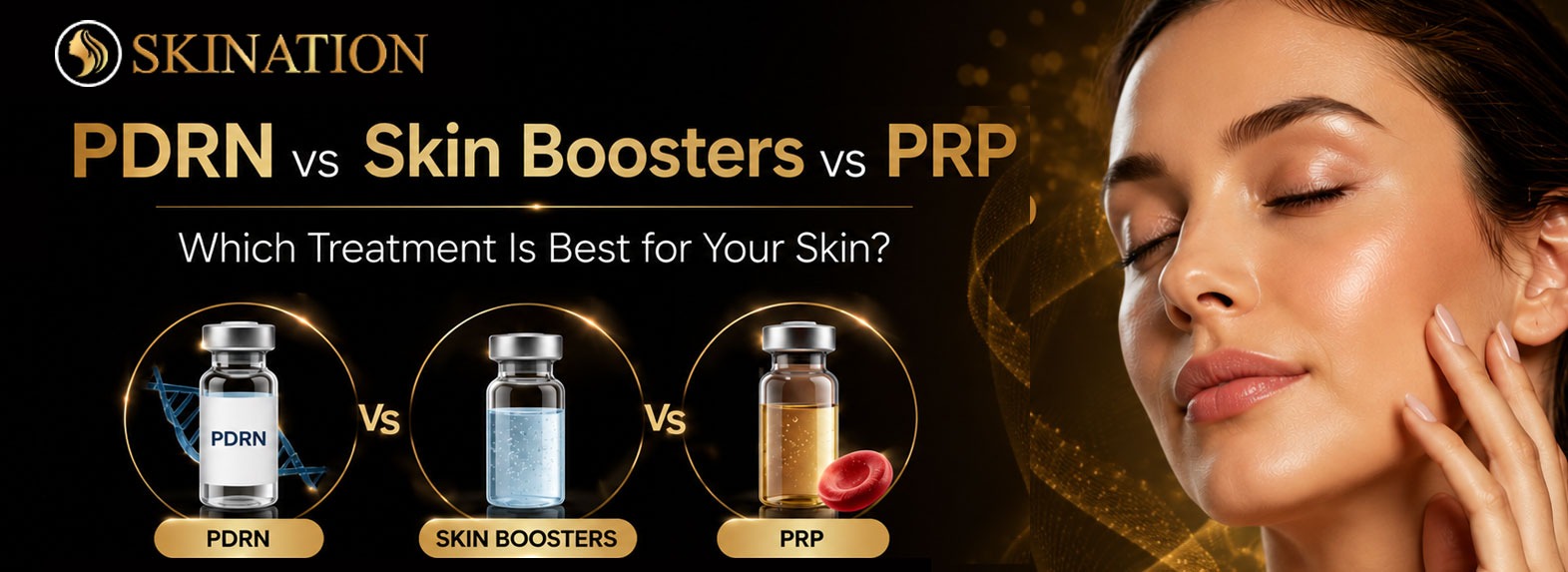
“Doctor, should I get PDRN, a skin booster or PRP?”
This is becoming an increasingly common question in aesthetic dermatology.
All three treatments are discussed in the context of skin quality, rejuvenation and healthier-looking skin. However, PDRN, skin boosters and PRP are not the same treatment, and they should not automatically be considered interchangeable.
One may be more appropriate for hydration, another for selected skin-quality concerns, while another may be useful when the goal is to use components derived from the patient’s own blood.
The right choice depends on your:
* Skin concern
* Skin type
* Age
* Degree of skin ageing
* Hydration status
* Texture
* Fine lines
* Previous treatments
* Medical history
* Treatment goals
The important question is therefore not:
“Which treatment is the best?”
It is:
“Which treatment is appropriate for my skin and my particular concern?”
What Are PDRN, Skin Boosters and PRP?
Before comparing them, it helps to understand what each treatment actually means.
What is PDRN?
PDRN stands for polydeoxyribonucleotide.
PDRN-based treatments are used in aesthetic dermatology with the aim of supporting skin repair and improving aspects of skin quality.
They are associated with processes involved in tissue repair and regeneration and may be used for concerns such as:
* Fine lines
* Uneven skin texture
* Dullness
* Reduced skin quality
* Dehydrated or tired-looking skin
* Early signs of ageing
Different PDRN products may vary in formulation, concentration, source and regulatory status.
Therefore, “PDRN” should not be treated as one identical product.
At Skination, treatment selection should be based on the individual patient and the specific product being considered.
What are skin boosters?
The term skin booster is used for injectable treatments designed primarily to improve aspects of skin quality rather than to create the structural facial volume associated with traditional dermal fillers.
Depending on the product, skin boosters may be used to improve:
* Hydration
* Skin smoothness
* Texture
* Fine lines
* Overall skin quality
Many skin boosters use hyaluronic acid or other formulations.
However, not every injectable marketed as a “skin booster” has the same composition or indication.
Therefore, it is important to know what product is actually being used.
What is PRP for skin?
PRP stands for platelet-rich plasma.
PRP is prepared from the patient’s own blood.
A blood sample is collected and processed to obtain a platelet-rich plasma fraction, which is then used according to the treatment protocol.
PRP has been used in dermatology and aesthetic medicine for selected skin and hair indications.
For skin, it may be considered in patients looking for improvement in aspects of:
* Skin texture
* Fine lines
* Overall skin quality
* Certain forms of skin rejuvenation
The evidence and protocols vary according to the indication and preparation method.
PDRN vs Skin Boosters vs PRP: The Basic Difference
A simple way to understand the three is:
Treatment What it primarily involves Common treatment goal
PDRN PDRN-based formulation Skin repair/quality and rejuvenation
Skin boosters Injectable skin-quality formulation, often based on HA or other substances Hydration and skin quality
PRP Patient’s own platelet-rich plasma Selected regenerative/rejuvenation applications
This table is only a broad overview.
The exact treatment, formulation and protocol matter.
Which Treatment Is Better for Dry or Dehydrated Skin?
If your main concern is dehydration, a skin-quality treatment designed specifically to improve hydration may be considered.
Certain skin boosters are specifically used for improving skin hydration and quality.
PDRN-based treatments may also be considered when the overall concern involves skin quality rather than dehydration alone.
PRP may be considered in selected rejuvenation protocols, but it is not simply a replacement for a hydrating skin booster.
The first step is therefore to determine whether the skin is genuinely dehydrated or whether it only appears dull because of another issue such as pigmentation, barrier dysfunction or accumulated sun damage.
Which Treatment Is Better for Fine Lines?
Fine lines can arise for different reasons.
They may be related to:
* Dehydration
* Reduced collagen and elastin
* Repeated facial muscle movement
* Sun exposure
* Ageing
* Reduced skin thickness
Therefore, PDRN, skin boosters and PRP do not necessarily address fine lines in exactly the same way.
If fine lines are primarily caused by repeated muscle movement, for example, the appropriate treatment may be completely different from a skin-quality injectable.
This is why a consultation is more useful than choosing a procedure based solely on the word “anti-ageing.”
Which Treatment Is Better for Skin Texture?
Texture can refer to several different things.
A patient may describe:
* Roughness
* Enlarged-looking pores
* Fine lines
* Acne scars
* Uneven skin surface
* Dullness
as simply “bad texture.”
But these are not the same problem.
PDRN, skin boosters or PRP may have a role in selected skin-quality concerns, but significant acne scars may require procedures such as microneedling, fractional resurfacing or other scar-directed treatments.
A dermatologist should therefore identify the cause of the texture problem before choosing an injectable treatment.
Is PDRN Better Than PRP?
There is no universal answer.
PDRN and PRP are different treatments.
PDRN uses a prepared formulation containing polydeoxyribonucleotide, while PRP is derived from the patient’s own blood.
They differ in:
* Composition
* Preparation
* Mechanism
* Protocol
* Product characteristics
* Evidence for specific indications
A patient should therefore not choose PDRN simply because it is newer or PRP simply because it uses their own blood.
The appropriate choice depends on the individual indication.
Is PDRN the Same as a Skin Booster?
No.
The terms are sometimes used interchangeably in aesthetic clinics and social media, but they are not necessarily synonymous.
A skin booster is a broader category describing injectable treatments intended primarily to improve skin quality.
PDRN refers to a specific type of active ingredient/formulation.
Some PDRN-based treatments may be discussed as skin-quality or regenerative treatments, but that does not make every skin booster a PDRN treatment.
Always ask what product is actually being used.
Can PDRN, Skin Boosters and PRP Be Combined?
In selected patients, combination treatment may be considered.
However, combining procedures does not automatically make the result better.
The dermatologist needs to consider:
* Your skin condition
* The treatment objective
* Timing
* Injection sites
* Previous procedures
* Potential irritation
* Recovery
* Whether the combination has a clinical rationale
The objective should be appropriate treatment, not the maximum number of procedures.
How Many Sessions Are Needed?
There is no universal number.
Treatment schedules depend on:
* The product
* The indication
* Skin quality
* Age
* Treatment goals
* Response to previous treatment
* Whether combination treatments are being used
A responsible treatment plan should explain the expected number of sessions and whether maintenance may be required.
Be cautious of claims that guarantee a particular number of sessions will produce a specific result.
How Long Do the Results Last?
Again, this depends on the treatment and individual response.
Skin quality naturally changes over time because of:
* Ageing
* Sun exposure
* Lifestyle
* Hormonal changes
* Skincare
* Underlying skin conditions
Therefore, no injectable should be presented as a permanent solution to ageing.
Your dermatologist should discuss both the expected benefits and the likely need for maintenance.
What About PDRN for Indian Skin?
Indian skin can respond differently to cosmetic procedures depending on skin type, pigmentation tendency and the underlying concern.
The important consideration is not whether a treatment is “for Indian skin.”
It is whether:
the treatment is appropriate for your skin, your indication and your risk of pigmentation or irritation.
A dermatologist should take into account your history of pigmentation, acne, sensitivity, previous procedures and sun exposure before recommending any injectable or energy-based procedure.
PDRN, Skin Boosters or PRP Before a Wedding?
This is where treatment planning becomes particularly important.
If you are considering a skin-quality treatment before a wedding or major event, do not schedule your first injectable procedure immediately before the event.
Temporary redness, swelling, tenderness or bruising can occur after injectable treatments.
Ideally, treatment should be planned with enough time for the skin to settle.
If you have several months before your wedding, your dermatologist has more flexibility.
If you have only a few days, the treatment strategy should be much more conservative.
Can These Treatments Replace Botox or Fillers?
No.
PDRN, skin boosters and PRP should not automatically be considered alternatives to Botox or dermal fillers.
Botox
Botulinum toxin primarily works by reducing activity of selected muscles.
It is commonly used for dynamic facial lines and other medical or aesthetic indications.
Dermal fillers are primarily used for selected applications involving volume, contouring or structural support.
Skin boosters are primarily intended to improve aspects of skin quality rather than provide the same structural volume as a traditional filler.
PDRN-based treatments are used in selected skin-quality and regenerative applications.
PRP
PRP uses the patient’s own platelet-rich plasma and may be used in selected regenerative and rejuvenation protocols.
These treatments therefore have different roles.
What If My Main Concern Is Pigmentation?
If pigmentation is your main concern, don’t assume that PDRN, PRP or a skin booster is automatically the appropriate first-line treatment.
The cause of pigmentation matters.
For example:
* Melasma
* Post-inflammatory pigmentation
* Tanning
* Freckles
* Sun-related pigmentation
may require different approaches.
Treatment may include sunscreen, prescription skincare, chemical peels, selected lasers or combination therapy depending on the diagnosis.
An injectable treatment may sometimes be used as part of an overall skin-quality plan, but it should not replace diagnosis and appropriate pigmentation treatment.
What If My Main Concern Is Acne Scarring?
Acne scars are another area where the correct diagnosis matters.
Different scars include:
* Ice-pick scars
* Boxcar scars
* Rolling scars
* Post-acne pigmentation
* Post-acne redness
A skin-quality injectable may improve the overall appearance of the skin in selected patients, but it does not automatically treat every type of acne scar.
Scar-specific procedures may be required.
What Questions Should You Ask Before Choosing a Treatment?
Before undergoing PDRN, a skin booster or PRP treatment, ask:
What is my actual skin concern?
What product will be used?
Why is this treatment appropriate for me?
How many sessions might I need?
What are the possible side effects?
How long is the recovery period?
When should I expect improvement?
Do I need maintenance?
What alternatives are available?
These questions help you make a decision based on your skin rather than social-media trends.
PDRN vs Skin Boosters vs PRP: Which One Should You Choose?
There is no single treatment that is best for everyone.
A simplified way to think about it is:
If your primary concern is hydration and skin quality: a suitable skin booster may be considered.
If your concern involves overall skin quality and a PDRN-based treatment is clinically appropriate: PDRN may be considered.
If you are interested in an autologous treatment using your own blood: PRP may be an option for selected patients.
But these categories overlap, and your dermatologist may recommend something entirely different after examining your skin.
Sometimes the best treatment is not one of these three.
For example, someone with active acne may need acne treatment first. Someone with significant melasma may need pigmentation-directed treatment. Someone with pronounced dynamic wrinkles may benefit more from botulinum toxin. Someone with significant volume loss may require a different aesthetic approach.
The Skination Approach: Choose the Problem First, Then the Procedure
At Skination Clinic, the aim of aesthetic dermatology should not be to sell a particular procedure.
It should be to identify the patient’s concern and select an appropriate treatment.
PDRN, skin boosters and PRP can all have a role in dermatology, but they are not interchangeable.
The best starting point is therefore not:
“Which treatment is trending?”
It is:
“What is happening to my skin, and what treatment has a reasonable clinical rationale for my concern?”
A dermatologist can then discuss the benefits, limitations, alternatives, expected timeline and maintenance requirements before you decide.
Frequently Asked Questions
Is PDRN better than PRP?
Neither is universally better. They are different treatments with different compositions and protocols. The appropriate option depends on the patient’s skin concern and treatment goals.
Is PDRN the same as a skin booster?
No. PDRN refers to a specific type of formulation, while “skin booster” is a broader term for injectable treatments intended primarily to improve skin quality.
Which is better for skin rejuvenation: PRP or PDRN?
Both may have a role in selected patients, but they should not be considered interchangeable. A dermatologist should assess the skin and determine which treatment, if any, is appropriate.
Which treatment is best for dehydrated skin?
Depending on the cause and severity of dehydration, a skin-quality or hydration-focused treatment may be considered. Skincare and barrier repair are also important.
Can PDRN and PRP be done together?
Combination treatment may be considered in selected patients, but there should be a clinical reason for combining treatments rather than simply adding procedures.
How many PDRN sessions are needed?
The number varies according to the product, indication, treatment protocol and individual response. Your dermatologist should recommend an appropriate schedule.
Can these treatments be used before a wedding?
They may be used in selected patients, but injectable treatments should be planned sufficiently before the event to allow temporary swelling, redness or bruising to settle.
Are skin boosters the same as dermal fillers?
No. Skin boosters are primarily intended to improve aspects of skin quality, while dermal fillers are used for selected applications involving volume and contouring.
Can PDRN treat acne scars?
PDRN may be considered as part of a skin-quality treatment plan in selected patients, but significant acne scars often require scar-specific procedures based on the type of scar.
Can these treatments permanently reverse ageing?
No. These treatments may improve selected aspects of skin quality, but ageing continues and maintenance, sun protection and appropriate skincare remain important.
How do I know which treatment is right for me?
A dermatologist should assess your skin, identify the primary concern and discuss appropriate treatment options, alternatives, expected benefits, limitations and potential side effects.