

✖

Aug, 08 2026
A pimple may disappear in a few days, but the reminder it leaves behind can last much longer. Some people are left with flat brown, red or grey marks. Others notice pits, depressions, uneven texture or raised areas that do not improve even after the acne has settled.
These concerns are often grouped together as “acne scars,” but acne marks and acne scars are not the same. They form differently, respond differently and need different treatment plans.
This is one reason why a cream that helps dark acne marks may not improve deep pitted scars. Similarly, a laser or procedure designed for scars may not be the first choice for fresh pigmentation after acne.
At Skination Skin & Hair Clinic, patients from Chhatarpur, South Delhi, Greenfield Colony and Faridabad frequently ask whether their marks will fade on their own or whether they need treatment. This guide explains the difference between acne marks and acne scars, the available treatment options and how to choose the right approach.
The Simple Difference Between Acne Marks and Acne Scars
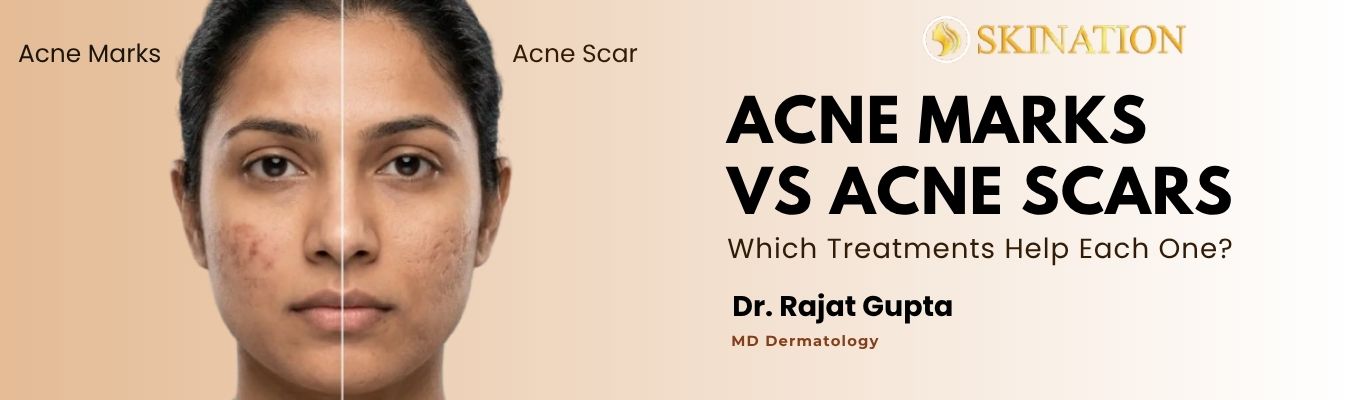
Acne marks are mainly a colour change in the skin after a pimple heals. The surface of the skin remains relatively smooth.
Acne scars are a change in skin texture. They happen when acne damages collagen during healing, leaving depressions, pits, thickened scars or uneven skin texture.
A useful way to check is to look at the skin from the side in natural light. If the area looks flat but darker, it is more likely to be an acne mark. If it creates a shadow, dip, pit or raised bump, it is more likely to be an acne scar.
Many patients have both at the same time. Treating the pigmentation may make scars look less obvious, but it will not fully correct textural depressions.
What Are Acne Marks?
Acne marks usually develop after inflammation. They are especially common after red, painful pimples, cystic acne, picking, squeezing or repeated breakouts.
The two common patterns are:
Post-inflammatory hyperpigmentation
Post-inflammatory hyperpigmentation, often called PIH, appears as brown, dark brown or grey-brown marks after acne heals. It is common in Indian skin tones because melanocytes can become more active after inflammation.
These marks are flat. They may fade gradually, but the process can take several months, especially when there is sun exposure, repeated acne or irritation from harsh products.
Post-inflammatory erythema
Post-inflammatory erythema, often called PIE, refers to red, pink or reddish-purple marks after acne. It is more visible in lighter skin tones but can also be present in Indian skin.
These marks are related more to blood vessels and inflammation than excess melanin. This is why treatment planning can differ from brown pigmentation.
What Are Acne Scars?
Acne scars develop when inflammation affects the deeper layers of skin and disrupts collagen repair. They are more likely after nodules, cystic acne, prolonged inflammation or repeated picking.
The main types include:
Ice-pick scars
These are narrow, deep scars that look like tiny punctures in the skin. They are often difficult to treat with creams alone because they extend deeper into the skin.
Boxcar scars
Boxcar scars are broader depressions with relatively defined edges. They can make the skin look uneven, particularly on the cheeks and temples.
Rolling scars
Rolling scars create a wavy or undulating appearance. They are often caused by fibrous bands pulling the skin downward from underneath.
Hypertrophic and keloid scars
These scars are raised rather than depressed. They are more common on the jawline, chest, shoulders and back. Keloids can extend beyond the original acne lesion and may need early treatment.
Why Acne Marks and Acne Scars Need Different Treatments
The goal in acne marks is to reduce excess pigment, inflammation or redness while preventing fresh acne.
The goal in acne scars is to remodel collagen, release tethered scar bands, improve texture and blend the scar with surrounding skin.
A patient with flat brown marks may improve with sunscreen, topical treatment and selected chemical peels. A patient with rolling scars may need subcision, often combined with microneedling radiofrequency, fractional laser or other collagen-stimulating treatments.
There is no single “best acne scar treatment” for every person. The most effective plans usually combine procedures according to scar type.
Treatment Options for Acne Marks
Daily sunscreen
Sunscreen is essential for acne marks. Ultraviolet radiation and visible light can darken post-acne pigmentation and make marks last longer.
A broad-spectrum sunscreen should be used daily. Tinted sunscreen may be particularly useful for people prone to pigmentation because it can offer additional visible-light protection.
Topical treatments
A dermatologist may recommend ingredients such as retinoids, azelaic acid, niacinamide, vitamin C, tranexamic acid, kojic acid or other pigment-regulating formulations depending on the skin type and acne activity.
Strong products should not be layered randomly. Over-exfoliation and irritation can trigger more pigmentation.
Chemical peels
Superficial chemical peels can help selected patients with acne marks, mild acne and uneven tone. The choice of peel depends on skin sensitivity, active acne, pigment tendency and downtime expectations.
Chemical peels should be planned carefully in Indian skin because overly aggressive treatment can cause post-inflammatory pigmentation.
Acne control
New acne creates new marks. If breakouts continue, treating acne is just as important as treating the marks left behind.
Treatment Options for Acne Scars
Subcision
Subcision is particularly useful for rolling scars and some tethered boxcar scars. A specialised needle or cannula is used beneath the skin to release fibrous bands pulling the scar downward.
It may be combined with other procedures depending on the scar pattern.
Microneedling
Microneedling creates controlled micro-injuries that stimulate collagen remodelling. It may help mild to moderate textural scars and can be part of a combination plan.
Multiple sessions are often needed, and results develop gradually as collagen remodels.
Radiofrequency microneedling
Radiofrequency microneedling combines needles with controlled heat energy. It may be useful for selected patients with acne scars, enlarged pores and textural concerns.
Treatment settings should be individualised, particularly for pigment-prone skin.
Fractional laser treatment
Fractional lasers can improve acne scar texture by stimulating collagen renewal. The choice of laser, intensity and downtime depend on skin type, scar type and risk of pigmentation.
Laser treatment is not automatically suitable for every patient. Proper pre-treatment and aftercare are important.
TCA CROSS
TCA CROSS is commonly considered for selected ice-pick scars. A high-strength chemical is carefully placed only inside the scar to stimulate local collagen repair.
It is a precise procedure and should be performed by an experienced dermatologist.
Fillers for selected scars
Some depressed scars may benefit from fillers, especially when there is volume loss or persistent indentation after subcision. Fillers are not appropriate for every scar and are usually part of a broader treatment plan.
Raised-scar treatment
Hypertrophic scars and keloids may need intralesional injections, silicone-based measures, laser treatment or other dermatology-led interventions. Early treatment can help reduce progression.
How Many Sessions Are Needed?
This depends on scar type, severity, active acne, skin type and the combination of treatments used. Most patients need a series of sessions rather than a one-time procedure.
Acne-scar treatment is usually about visible improvement, not perfection. A realistic plan focuses on smoother texture, softer shadows, reduced depth and better overall skin quality.
Photographs taken in consistent lighting can help track progress more accurately than checking the mirror every day.
Can Creams Remove Acne Scars?
Creams can improve pigmentation, mild uneven tone and some surface texture. They cannot fully remove deep ice-pick, boxcar or rolling scars because these scars involve structural changes beneath the skin.
A good skincare routine remains important before, during and after procedures because it supports barrier health, reduces acne recurrence and helps maintain results.
When Should Acne Scar Treatment Begin?
Active acne should usually be controlled before intensive scar treatment. Treating scars while new inflammatory acne continues can lead to fresh marks and scars.
However, early consultation is still useful. A dermatologist can start acne control, advise on scar-prevention habits and plan future procedures at the right time.
Avoid picking pimples. This is one of the simplest ways to reduce the risk of deeper scars and prolonged pigmentation.
Frequently Asked Questions
Do acne marks fade naturally?
Many acne marks fade over time, especially if acne is controlled and sun protection is consistent. Darker marks can take several months, and treatment may speed improvement.
Can acne scars disappear completely?
Deep acne scars rarely disappear completely, but modern combination treatments can make them significantly less visible and improve skin texture.
Which treatment is best for pitted acne scars?
The best treatment depends on whether scars are ice-pick, boxcar or rolling. Subcision, TCA CROSS, microneedling, radiofrequency microneedling and fractional lasers may be used alone or in combination.
Is chemical peeling useful for acne scars?
Chemical peels are more useful for acne marks, mild acne and superficial uneven tone. They do not usually correct deep pitted scars on their own.
Can I use home remedies for acne marks?
Lemon, toothpaste, harsh scrubs and DIY bleaching mixtures can irritate the skin and worsen pigmentation. A gentle routine and dermatologist-guided treatment are safer.
Are acne-scar procedures safe for Indian skin?
They can be safe when the procedure, settings, preparation and aftercare are selected carefully. Indian skin may be more prone to post-inflammatory pigmentation after aggressive treatment.
Consult for a Personalised Acne Mark and Scar Plan
The first step is identifying whether your concern is colour, texture or both. Once the diagnosis is clear, treatment can be planned more efficiently and unnecessary procedures can be avoided.
For acne marks, pitted acne scars and post-acne pigmentation treatment in Chhatarpur, South Delhi and Greenfield Colony, Faridabad, consult Dr. Rajat Gupta at Skination Skin & Hair Clinic.